

CRC 1182 speaker Hinrich Schulenburg awarded ERC grant to investigate hidden tricks in the evolution of organisms
The European Research Council is funding the “CrypticBenefits” research project at Kiel University, which uses the evolution of antibiotic resistance as a case study to investigate how hidden genetic diversity underpins the rapid adaptation of microorganisms to a changing environment.
Evolutionary research in Kiel has achieved another major success in 2026: Hinrich Schulenburg, Professor of Evolutionary Ecology and Genetics at the Institute of Zoology at Kiel University, has been awarded an Advanced Grant by the European Research Council (ERC) in the Life Sciences category. The ERC announced this today, Tuesday 23 June. With this substantial research grant of 2.5 million euros, Schulenburg and his team will be able to embark on a new project, titled “Cryptic phenotypic heterogeneity as a key adaption to fluctuating environments” (short: ‘CrypticBenefits’), over the next five years.
Specifically, the aim is to investigate a principle of evolutionary adaptation to unpredictable environmental conditions that has received little attention to date. The focus is on the phenomenon of hidden variation, whereby an organism always produces a very small number of offspring that expresses different characteristics to the remaining majority of offspring. This hidden variation is not a major disadvantage if the environment remains constant. However, if the environment does change, then at least a few offspring are adapted and can ensure the organism’s survival. The significance of this hidden variation is being characterized using the example of the evolution of antibiotic resistance in bacterial pathogens. The ERC grant now awarded offers fantastic opportunities for this research and, at the same time, represents a unique distinction for Schulenburg in a highly competitive, multi-stage EU funding scheme with a success rate of less than ten per cent of applications submitted.
“On behalf of the entire university board, I would like to offer Hinrich Schulenburg my warmest congratulations on this outstanding achievement. The award of an ERC Advanced Grant is a very special honour, granted through a highly competitive process to researchers whose achievements and research ideas set international standards. The funding for the planned research project is a particular recognition of Hinrich Schulenburg’s scientific excellence and his international standing as an evolutionary biologist. We are delighted that such a prestigious grant has been awarded to a member of Kiel University, thereby further enhancing the profile of evolutionary research and Kiel as a centre of research. This will enable Kiel University, together with its partner institutions, to further build on its position – unique in Germany – in this field of research, which is of particular relevance to society,” emphasises Professor Eckhard Quandt, Kiel University’s Vice-President for Research.
CrypticBenefits: How genetic ‘outliers’ can ensure a species’ evolutionary success
Unpredictable fluctuations in the environmental conditions are everywhere and constitute a key driver of evolution. However, the mechanisms underpinning adaptations to such unpredictability remain poorly understood. “With this new research project, we aim to investigate how evolutionary adaptations to unpredictable changes in the environment can arise through the principle of hidden variation,” says Schulenburg. The occurrence of this cryptic phenotypic heterogeneity is genetically controlled; whilst it is very rare, it is nevertheless significantly more common than random mutations.
“We assume that this mechanism represents a kind of evolutionary safety mechanism, whereby organisms retain the capacity for rapid adaptation at very little cost. A variant that is, so to speak, kept hidden can then offer a decisive advantage should certain environmental changes make this necessary,” explains Schulenburg. This cryptic phenotypic heterogeneity may thus offer a dual selective advantage: it minimises the evolutionary costs for a species as long as environmental conditions remain stable, whilst at the same time ensuring the presence of advantageous variants should these conditions change unexpectedly.
Applying an evolutionary perspective from research to practical application
The project’s central aim is therefore to investigate the adaptive advantages of cryptic phenotypic heterogeneity and to understand its implications. “To this end, we are using the interaction between a bacterial pathogen and antimicrobial drugs as an informative model that is ideally suited for experimental investigation and offers an ideal starting point for an in-depth evolutionary analysis,” Schulenburg continued. Beyond elucidating the fundamental significance of the phenomenon, this may also be of applied value: Hidden variation in antibiotic resistance is already known in medicine as heteroresistance and poses a major problem in diagnostics and the resulting treatment decisions. Research into the underlying processes can therefore help to develop new strategies for diagnostics and antibiotic therapy.
“This new research project is a prime example of our general objective to translate findings from evolutionary biology into novel interventions. In doing so, we are adding another building block to the numerous research projects on translational evolutionary biology in the Kiel region,” summarises Schulenburg, who is the spokesperson for the Research Training Group (RTG) “Translational Evolutionary Biology “(TransEvo) at Kiel University and also conducts research as a fellow at the Max Planck Institute for Evolutionary Biology (MPI-EvolBio) in Plön. The common aim of these research projects is to find sustainable solutions to various contemporary societal challenges – in this case, the man-made antibiotic crisis, which is currently escalating dramatically; to tackle this crisis, the integration of an evolutionary biology perspective into research and clinical practice is essential.
Images are available for download:
www.uni-kiel.de/de/pressemitteilungen/2026/108-schulenburg-ERC-hs.jpg
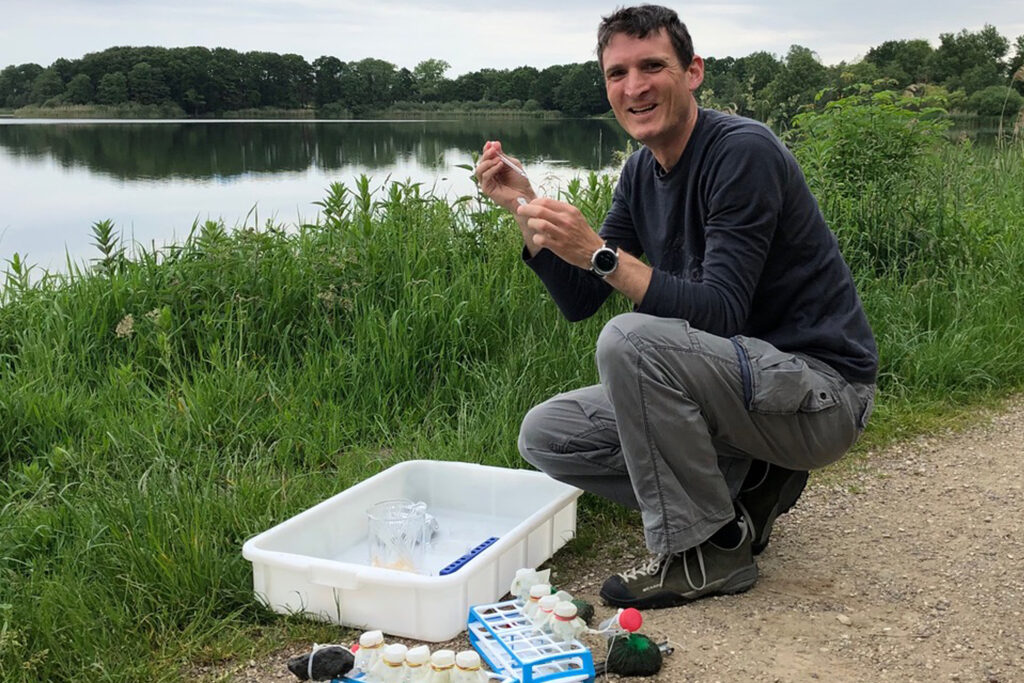
Caption: Hinrich Schulenburg, Professor of Evolutionary Ecology and Genetics at Kiel University has been awarded an ERC Advanced Grant for the research project ‘CrypticBenefits’.
© private
Contact:
Prof. Hinrich Schulenburg
Evolutionary Ecology and Genetics group, Head
Zoological Institute, Kiel University
Phone: +49 431-880-4141
Email: hschulenburg@zoologie.uni-kiel.de
More information:
Evolutionary Ecology and Genetics group,
Zoological Institute, Kiel University:
www.evoecogen-kiel.de
Research Training Group (RTG)
„Translational Evolutionary Research (TransEvo)”, Kiel University:
www.transevo.de
Kiel Evolution Center (KEC), Kiel University:
www.kec.uni-kiel.de
Max Planck Institute for Evolutionary Biology (MPI-EvolBio), Plön:
www.evolbio.mpg.de
Priority research area Kiel Life Science (KLS), Kiel University:
www.kls.uni-kiel.de
Press release from the European Research Council on the latest ERC grants:
erc.europa.eu/news-events/news/erc-2025-advanced-grants-results