A Hub for International Metaorganism Research in Kiel
Leading international researchers in the field of host-microbe interactions, including DFG Mercator Fellow Brendan Bohannan, as well as researchers from Norway and Canada, are gathering in Kiel for the annual meeting of the CRC 1182.
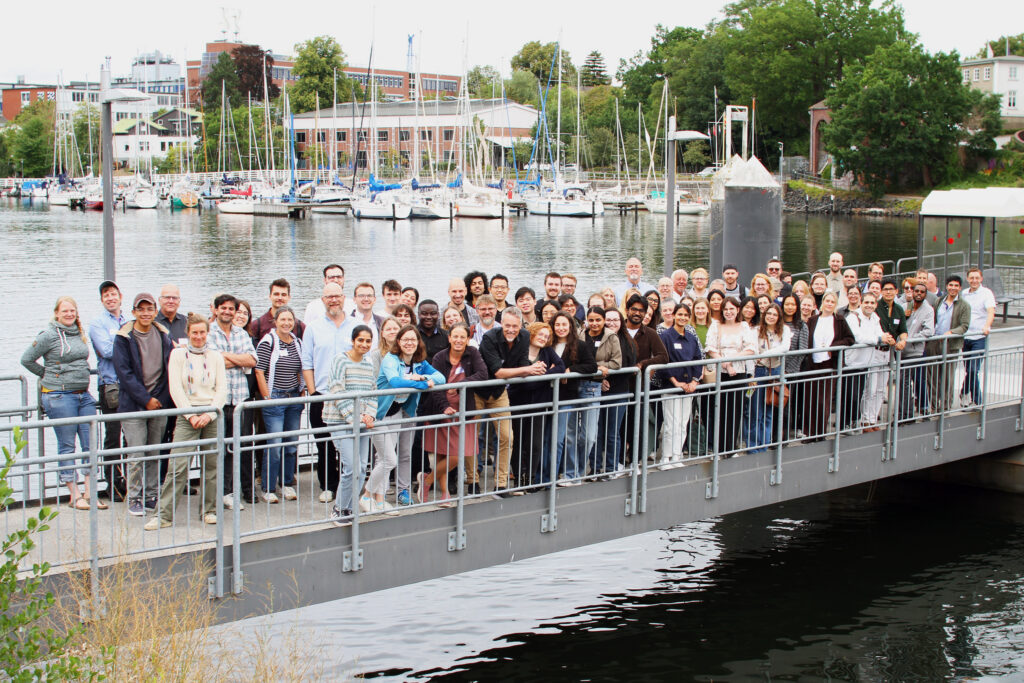
The Collaborative Research Center (CRC) 1182 “Origin and Function of Metaorganisms” at Kiel University is currently hosting its annual meeting for members and international guests. About 100 scientists from numerous fields of host-microbe research are gathering for the event at the GEOMAR Helmholtz Center for Ocean Research Kiel. The CRC 1182 includes not only Kiel University but also GEOMAR, the Max Planck Institute for Evolutionary Biology in Plön, Heinrich Heine University Düsseldorf, the Muthesius University of Fine Arts in Kiel, and the Leibniz Institute for Science and Mathematics Education (IPN). Since its founding in 2016, it has developed into an international hub for metaorganism research thanks to continuing funding from the German Research Foundation (DFG). Since then, researchers in Kiel, together with their collaboration partners, have made fundamental progress in answering the question of why and how microbial communities form long-term relationships with their host organisms and what functional effects these interactions have on health and disease.
This year, this prominent position is reflected, among other things, in the contribution by DFG-Mercator Fellow Professor Brendan Bohannan of the University of Oregon. He has long been associated with metaorganism and evolutionary research in Kiel. This year; he will deliver a keynote lecture at the CRC 1182 meeting, and present current findings together with members of his research group. In addition, the CRC meeting also hosts the members of the IPAMA consortium, the International Partnership for Advancing Microbiome-informed Aquaculture, including researchers from Eugene, US; Trondheim, Norway; and Quebec City, Canada, who are presenting their most recent work on the effects of the microbiome on aquaculture. “We are very happy that colleagues from around the world have joined us this year and enrich our meeting with their fascinating research and innovative ideas. In addition to the excellent work of our members in Kiel, it is these contributions from the international community that inspire the research within our center for metaorganism research at the highest level,” emphasizes CRC 1182 spokesperson Professor Hinrich Schulenburg of Kiel University.
Metaorganism research in Kiel remains a flagship of scientific excellence
When the CRC 1182 was founded more than 10 years ago, researchers in Kiel filled a gap in the national research landscape and created one of the first major research networks in Germany dedicated specifically to investigating the interaction between host organisms and their microbiomes and the resulting effects on health and disease. During this time, the CRC members succeeded in gathering numerous novel insights into the functions and effects of host-microbe interactions using various model organisms, ranging from nematodes to wheat plants to humans. This research work yielded a better understanding of several life history processes influenced by microorganisms, such as nutrient uptake, immune function, and neural processes that determine the health and disease of an organism as a whole.
International research trends: geographic concepts for microbiome research
Mercator Fellow Bohannan, who is currently completing his annual research stay at Kiel University, is once again contributing to metaorganism research in Kiel with his innovative work. Through its Mercator Fellowships, the DFG fosters intensive, long-term exchange between members of a DFG-funded research network – such as the CRC 1182 – and renowned scientists from Germany and abroad.
These Mercator Fellows – who at Kiel University also include Professor Jessica Metcalf of Princeton University – visit their host universities once a year and regularly perform research in collaboration with their local colleagues. In addition, they provide conceptual insights for the future direction of the joint research field. Metcalf and Bohannan, together with an international team of authors, recently provided such an impetus in the form of a new perspective article in the journal Trends in Microbiology, which addresses the biogeography of microbial communities: In this case, it is focused on parallels between the transmission of microorganisms between hosts and the dispersal of species among geographic islands.
“Variations in the microbiome cannot be explained by the host organism alone, since microbiomes are shaped not only by host characteristics but also by a variety of external ecological processes. The theory of island biology is extremely helpful in this context., It can be used to define animal hosts as islands and animal microbiomes as metacommunities that form within the host islands and spread between them,” says Bohannan. Even though the spread of microbial communities is more complex than this model suggests, it still enables an improved understanding of the process of ‚island-to-island’ spread of microbiomes across their hosts, the evolutionary biologist from Oregon continues.
“We would like to extend our special thanks to Jessica Metcalf and Brandon Bohannan, who have supported us for many years within our research networks and have been a major source of inspiration for microbiome and evolutionary research here in Kiel,” emphasizes Professor Tal Dagan of Kiel University, vice-spokesperson for the CRC. “At the same time, new ideas and connections are also of great value: The collaboration with our colleagues from the IPAMA project is very enriching for us. The topic of aquaculture opens up a new and transfer-oriented field for us in the study of host-microbiome interactions,” Dagan continues.
Contact:
Prof. Hinrich Schulenburg
Spokesperson CRC 1182
„Origin and Function of Metaorganisms“, Kiel University
Phone: +49 431-880-4141
Email: hschulenburg@zoologie.uni-kiel.de
Original publication:
Amar Sarkar, Aura Raulo, Mason R. Stothart, Neil G.O. Ibata, Siobhán Hart, C. Jessica E. Metcalf, Brendan J.M. Bohannan, Gordon M. Bennett and Rachel N. Carmody (2026): The island biology of the host microbiome. Trends in Microbiology.
First published: 2 June 2026 DOI: 10.1016/j.tim.2026.03.001
More information:
Environmental Studies and Biology (Bohannan Lab),
Institute of Ecology and Evolution,
University of Oregon, Eugene:
pages.uoregon.edu/bohannanlab
Disease Modelling and Demography (Metcalf Lab),
Department of Ecology & Evolutionary Biology,
Princeton University:
https://metcalflab.princeton.edu